
From live-floor infeed drives on industrial chippers to the perimeter ring drives on tub grinders to the crawler undercarriages that carry tracked machines across muddy cutovers, our components are engineered for continuous mechanical throughput under punishment. With almost 80 years of manufacturing from a single plant in Milwaukee, Wisconsin, we stand behind every part we ship.
When the Feed Stops, Everything Stops
In a wood-waste yard or on a logging deck, downtime is not an inconvenience — it is thousands of dollars an hour in idled crews, stalled trucks, and blown project timelines. A skipping infeed sprocket, an elongated drag chain, or a track that jumps off its idler can shut a machine down for days. Worse, a single misaligned tooth on a tub drive can stall the tub entirely or destroy an expensive hydraulic orbit motor.
That is why forestry OEMs and fleet maintenance managers specify Cogmatic. We do not sell generic replacement parts. We engineer rotary power transmission components that hold their tooth profile, resist the abrasive slurry of soil and wet bark, and keep chains tracking smoothly shift after shift. When paired with the industry’s toughest chains, our sprockets are built to survive the production season. Toughness is not a slogan here — it is guaranteed and measured.
Tough Jobs Demand Tough Steel
Low-carbon steel and cast alternatives can crack, deform, and gall under the load of whole-tree processing. Cogmatic manufactures its sprockets and gears exclusively from high-quality, domestically sourced mid- to high-carbon U.S. plate steel. That metallurgy is what makes our heat treating possible.
Using in-house induction hardening and deep carburizing, we’re able to elevate tooth flank and tip hardness up to 60–65 Rockwell-C. Just as important, we engineer a hardness gradient into every tooth: the outer wear surfaces are hardened to shrug off abrasive soil and grit, while the inner core stays. Consequently, when a large stump jams a chipper drum, the tooth absorbs the shock instead of shattering. Hard where it needs to resist wear, tough where it needs to survive impact.


Flame Machining: A Single-Pass Path to Accuracy
Cogmatic cuts every tooth profile with our proprietary high-pressure oxy-propane flame machining process. Traditional CNC cold machining is slow and prohibitively expensive at large diameters, and standard flame cutting leaves jagged, carbon-depleted edges that wear out fast. Our dual-axis pathing system delivers the value solution — it cuts a precise, clean profile in a single continuous pass.
As a result, tooth pitch stays uniform, and the finished flanks are smooth to a surface condition of 125 microinches. That smooth finish matters in the field: it lets heavy engineered chain engage and disengage with minimal friction, reduces drive-motor torque spikes, and gives debris nothing to cling to.
Power Transmission Manufacturing Range at a Glance
|
Parameter |
Range |
Why It Matters in Forestry |
|---|---|---|
|
Outer diameter |
12 in to 18 ft |
Scales from compact drive sprockets to full tub-grinder perimeter drives |
|
Face width |
Up to 5 in |
Spreads drive torque across a wider tooth, minimizing localized peening |
|
Chain pitch |
1 in and larger |
Matches heavy engineered chain such as WDH-110, WDH-120, and custom profiles. Fat tooth designs for D7-D10 chain & a wide range of Berco products |
|
Gear diametral pitch (DP) |
3 to ¾ DP, 8.5 to 30 Mod |
Coarse pitches mean larger, stronger teeth that carry the high-torque, low-speed shock of chipper and grinder gear drives without fracturing — and offering both DP and Module standards lets us match imperial and metric designs alike |
|
Case hardness |
Up to 60–65 Rockwell-C |
Resists soil, sand, and bark abrasion — often doubling sprocket life |
|
Tolerances |
Within ±0.005 in |
Ensures concentricity and alignment on mating surfaces, eliminating vibration and premature wear |
|
Segmented & split configurations |
2-piece and 4-piece |
Lets crews replace sprockets on the shaft without removing the chain or bearings |
Core Forestry Applications
Drum Chippers
High-volume drum chippers turn tree-length logs and brushy limbs into uniform chips for the pulp and biomass markets, and they depend on positive, aggressive feeding to do it. Heavy live-floor infeed systems and large top compression feed rolls pull material into the drum, driven by multiple strands of heavy-duty drag chain — such as WDH-110 or WDH-120 welded steel chain — running under immense tension.
Those drive sprockets take a beating from shock loads, wood-sap acidity, and the abrasive soil embedded in tree bark. Standard sprockets lose their tooth profile quickly, and the chain begins to skip, jump teeth, or slip. Cogmatic flame-machines the tooth pockets to exact pitch clearance and induction-hardens the wear flanks up to Rc60, so the sliding abrasion of the drag-chain links no longer grinds down the sprocket bed. The result is smooth engagement, lower motor torque spikes, and dramatically longer chain & sprocket life.

Horizontal Grinders
Horizontal grinders reduce bulky wood waste, storm debris, and land-clearing material into high-value mulch and compost fiber. Because they process dirty feedstock, sand, gravel, and surface soil sift through the material and contaminate the chain path. As the infeed chains — WDH-110, WDH-120, or custom profiles like Peterson WDH-121 — drag across the floor, that trapped debris becomes a grinding slurry that chews through sprocket tooth flanks and causes pitch mismatch and chain elongation.
Furthermore, these machines run variable-speed intelligent feed systems that constantly adjust feed rate to engine load and rotor pressure, subjecting the drive sprockets to rapid acceleration and deceleration. Cogmatic’s engineered sprockets take both hits: the ductile high-carbon core cushions the dynamic torque reversals, while the deep induction-hardened case resists the abrasive grind of dirt and stones. Consequently, pitch stays true, and the chain tracks smoothly without binding.
Tub Grinders
Tub grinders use gravity to feed massive stumps and root balls into a hammermill at the base of a rotating tub. That tub is driven by a continuous roller-chain sprocket ring — often running ANSI #120H or #160 chain — wrapped completely around the tub base and powered by low-speed, high-torque hydraulic orbit motors. With tub diameters exceeding 7 to 10 feet, maintaining perfect concentricity across that circumference is a serious engineering challenge.
Any out-of-round distortion or variation in tooth spacing leads immediately to chain whip, tension loss, or binding. In extreme cases, a single high tooth causes the chain to jump, stalling the tub or damaging the drive motors. Cogmatic manufactures concentric large-diameter ring sprockets and segments up to 18 feet across, machined to hold precise pitch around the full circle. Accordingly, tub drives with Cogmatic’s large diameter ring sprockets rotate smoothly, with even load distribution and no drive slippage.

Debarkers
Chain-flail debarkers strip bark from harvested timber before chipping to produce clean, high-grade pulp and paper chips. The feed rolls that pull logs through the debarking chamber work in a wet, acidic, bark-heavy environment, where wood fibers, moisture, and organic acids combine into an aggressively corrosive paste that coats every drive component. Standard cast-iron or low-alloy sprockets suffer rapid galvanic and abrasive wear, and the constant feeding of uneven logs hammers the shafts and sprockets with radial and axial shock.
Cogmatic’s engineered chain sprockets and custom drive gears stand up to that combination of chemical and physical attack. Our high-purity U.S. carbon steel limits chemical pitting, while the induction-hardened flanks resist the abrasive wear of the woody slurry. By holding accurate pitch engagement under wet, high-load conditions, our sprockets prevent drive slipping and keep log throughput constant.
Whole Tree Chippers
Whole-tree chippers ingest entire trees, tangled slash, and full limbs in a single pass. The sloped infeed floor and top feed rolls must maintain relentless, positive feed pressure while the drive absorbs violent torque spikes every time a large stem hits the drum. Any hesitation in the feed system chokes production.
This is exactly the environment Cogmatic components are built for. Our high-carbon steel core stays ductile and acts as a shock absorber during those sudden torque spikes, while the deep induction-hardened case resists the grit and bark abrasion that destroys ordinary sprockets. Accurate, flame-machined pitch keeps the high-tension WDH-120 drag chain seated and tracking, so the machine keeps swallowing whole trees without binding or slipping.
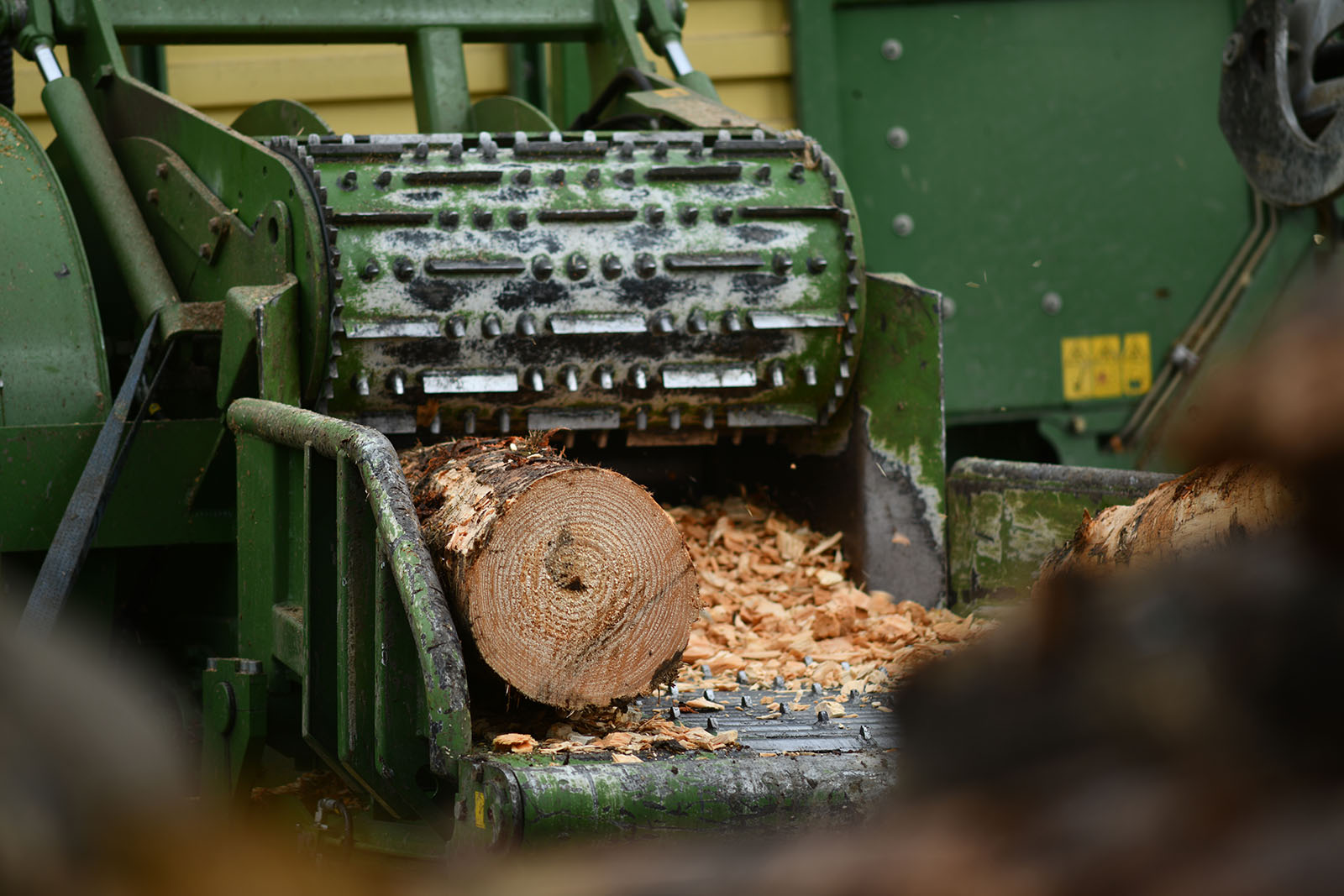

Pulp Processing
Before a single fiber becomes paper, the woodyard has to move mountains of material — and it all moves on chain and gear. Log decks, infeed conveyors, drum debarkers, chippers, and chip-reclaim systems run around the clock, often in wet, acidic, grit-laden conditions that chew through undersized drives. When a conveyor stalls or a debarker ring binds, the whole mill’s front end starves.
Cogmatic builds the sprockets and gears that keep pulp-grade chips flowing: heavy-tooth drive sprockets for log-deck and infeed chain, large-diameter ring and segmented drives for rotary drum debarkers, and abrasion-hardened sprockets for chip and reject conveyors. Case hardening up to 60–65 Rockwell-C shrugs off the sand and bark that ride in with every load, while ±0.005 in concentricity keeps long conveyor runs tracking true — no vibration, no premature chain wear. And because pulp mills live and die by uptime, our segmented and split configurations let crews swap a worn sprocket on the shaft in a single shift, without pulling the chain or bearings. From the woodyard to the chip pile, Cogmatic power transmission products are built to keep the fiber moving.
Undercarriages
Tracked chippers, horizontal grinders, and tub grinders—many running Caterpillar undercarriages such as the CAT 312B, 320L, or 325L—must move across steep grades, deep mud, wetlands, and abrasive slash. Under those conditions, standard crawler sprockets fail from mud packing and wood-chip accumulation. As the machine turns, wet fibers, bark, and soil compress into the track-chain bushings and sprocket teeth, altering the operating pitch and driving tension spikes, bushing peening, and ultimately track derailment.
Cogmatic solves this with custom crawler sprockets featuring mud-relief notches machined directly into the root diameter of the flame-machined teeth. As the bushing engages, compressed mud and debris are forced out through the notches instead of packing tight, so the track holds proper pitch and alignment. The ultra-smooth flame-machined profile gives debris nothing to cling to, and the Rc60 case-hardened flanks resist peening, ratcheting, and premature wear — keeping heavy tracked machines moving across the roughest ground.

Replace Sprockets in a Shift – NOT a Shutdown
We work with our OEM customers’ engineering teams to design our sprockets to last through the entire production season. However, these are mechanical products in brutal environments, and sometimes stuff happens, so ease of replacement becomes critical. On a high-throughput grinder or chipper, the price of the part is dwarfed by the cost of the downtime it takes to install it. Replacing a solid-ring drive sprocket on an infeed shaft traditionally means disconnecting the drive motors & chain, pulling the bearing assemblies, and sliding the entire shaft out of the frame — a job that can consume several days and stall everything downstream.
Cogmatic eliminates that bottleneck with split sprockets and segmented rim assemblies. Our process is unusual and deliberate: each split sprocket is first fabricated, flame-machined, and induction-hardened as a single solid ring, guaranteeing exact concentricity and tooth pitch. Only as a final step is it split into two- or four-piece segments, complete with high-precision spacer pins and custom patch plates, match-marked for assurance that the product will be installed as intended. Bolted back together in the field, the segments replicate the performance of a solid ring — but a technician can install one directly on the shaft in a single shift, with no bearing or coupling teardown.
|
Configuration |
Field Installation |
Concentricity |
|---|---|---|
|
Solid-ring |
Full disassembly of shaft, bearings, and motor couplings |
Perfect continuous geometry, zero joints |
|
Match-marked split sprocket |
Bolts onto the existing drum or shaft with patch plates and aligner pins |
Machined as a solid ring, then split to preserve tolerance |
|
Segmented rim assembly |
Bolts to a permanent center-hub flange; quadrants swap individually |
Modular; worn sections replace without pulling the whole gear |
Quality Management & Traceability
Every Cogmatic sprocket and gear moves through an ISO 9001:2015-certified quality workflow built to catch failures before they reach the field. It starts at raw-material receiving: all domestic U.S. plate steel arrives with official mill certifications, and the mill heat number is stamped onto each blank and tracked through flame machining, heat treating, welding, finish machining, and packaging. That full traceability is exactly what OEM customers need for their equipment warranty logs.
During induction hardening, high-accuracy temperature sensors monitor the heating and quenching cycles to confirm consistent case depth and hardness across every tooth flank. Prior to delivery, Cogmatic uses calibrated hardness testers to verify the Rc60–Rc65 rating, and validates that the product matches the design print. Complete inspection reports and material test certs ship with the finished components, so buyers have documented proof of what they are installing.
Collaboration Without Complication
Cogmatic’s Wisconsin-based engineering team works as an extension of your own. Send us a 3D CAD model, a legacy paper drawing, or even photos of a worn-out competitor sprocket, and we will handle the reverse engineering and Design-for-Manufacturability review. Whether you need a single custom replacement or a production run for a new machine platform, you deal directly with the people who build the part.
Sustainability & Long-Term Value
A sprocket that lasts twice as long is a sprocket you buy half as often — less scrap, fewer shipments, and less machine downtime over the life of the fleet. By starting with domestic steel, hardening it to resist forestry’s worst abrasion, and machining it to hold pitch far longer than cast or low-carbon alternatives, Cogmatic components lower the true cost of ownership while keeping equipment productive.
Built to Keep Forestry Moving
- Solid U.S. plate-steel or forged ring sprockets, gears, rings, and racks — no castings, no compromises
- Teeth induction-hardened up to Rc60–Rc65 over a ductile, shock-absorbing core
- Single-pass flame machining for cost-effective pitch accuracy at any diameter
- Mud-relief crawler sprockets that eject debris and stay on track
- Match-marked split and segmented designs that cut downtime from days to hours
- Full ISO 9001:2015 traceability, from mill heat number to final inspection report
When reliable, long-lasting drive components are non-negotiable, forestry OEMs and fleets turn to Cogmatic for proven solutions built for uninterrupted operation in the most demanding wood-processing environments.
Questions & Answers
Keep Your Operation Running
Count on Cogmatic to keep the wood moving. Request a quote today and let our engineers tailor the right sprocket, gear, ring, or rack for your forestry equipment.